BLAINE, WA, Dec. 4 /CNW/ - Century Mining Corporation (CMM: TSX-V) today announced that management is diligently continuing its efforts towards the completion of documentation and closing of the previously reported US$33 million prepaid gold facility with a major international bank and the $21 million private placement. Further to previous press releases, the Company now expects that closing of these financings will be prior to the Christmas Holidays.
Margaret Kent, President and CEO of Century commented, "Other than finalization of documentation, no other significant business issues remain that affect the closings".
Friday, December 4, 2009

John Williams comments of the US$ pending collapse
He has a website which takes published government statistics and adjusts them to realistic or historical measurements (i.e. how the unemployment rate was calculated during the Great Depression). He is well respected.
I think his views in the following article are a bit too extreme for me, but I agree with his fundamental theories. How the US will financing nearly $5 trillion in 2010 alone without printing a lot of new dollars is way beyond me - when their annual revenues are only $2.1 trillion, and of that money $400 billion automatically goes towards paying down interest on debt, and a lot that annual revenue will already be allocated for annual budgeted operating commitments (they already have problems balancing the annual budget as is).
The article was written by Greg Hunter. Here is the part of the article as it pertains to John Williams:
Dec 4 2009 2:28PM
Ben Bernanke's Hyperinflation And Economic Collapse
In Williams latest report he writes “The United States Economy and Financial System Face an Eventual Great Collapse.” Williams told me in an interview this week that because of all the bailouts, stimulus packages, giveaways and short-term debt, the U.S. has to finance nearly $5 trillion in 2010 alone. That’s about $96 billion in debt auctioned off each and every week!! Williams said, “Someone has to buy those Treasuries, and if no one does, then the Federal Reserve will become buyers of last resort.” The Fed buying that much in Treasuries is the same as printing huge amounts of money. Williams says that “is the tipping point that will start a dollar crisis.” According to Williams, this will produce a “high risk of an ultimate dollar crisis that will begin unfolding in year ahead.”
Inflation created by this “dollar crisis” will turn into hyperinflation within 5 years. Government and Fed actions have caused this problem and Williams sees “no way out,” and “hyperinflation is just a matter of time.” The hyperinflation forecasted by Shadow Government Statistics will look like Weimar Germany in the early 1920’s. The dollar will rapidly lose value to the point it will take a wheelbarrow full of cash to buy a loaf of bread or a gallon of gas. Anyone on fixed income or holding dollars will be wiped out according to Williams.
The Gold market seems to be reflecting the fear of inflation and a weakening dollar. Big central banks are buying Gold. India bought 200 metric tons of the yellow metal last month. Other countries, such as China and Russia, are also gold buyers. Retail investors are, likewise, beginning to flock to gold. Arthur Blumenthal of Stack’s Rare Coins in New York City has been in the gold and coin business since 1974. Stack’s opened its doors in 1934 and is the oldest coin dealer in America. Blumenthal saw the “go-go years” of the late seventies gold market firsthand. Blumenthal told me, “I have never seen anything like this before! There are only buyers.” He says many of his customers are “Wall Street types who are buying physical gold for the first time.”
Williams says buying gold and silver “long term” will be your best defense against a “great collapse…dollar crisis… and hyperinflation.” Williams also says you should stock up on food and other necessary supplies because the coming crisis will create shortages in all sorts of things.
I predict Mr. Bernanke will keep his job at the Federal Reserve. That might be poetic justice because this Fed Chief should witness his handy work firsthand. What is coming to America might go down in history as Ben Bernanke’s Hyperinflation and Economic Collapse.
I think his views in the following article are a bit too extreme for me, but I agree with his fundamental theories. How the US will financing nearly $5 trillion in 2010 alone without printing a lot of new dollars is way beyond me - when their annual revenues are only $2.1 trillion, and of that money $400 billion automatically goes towards paying down interest on debt, and a lot that annual revenue will already be allocated for annual budgeted operating commitments (they already have problems balancing the annual budget as is).
The article was written by Greg Hunter. Here is the part of the article as it pertains to John Williams:
Dec 4 2009 2:28PM
Ben Bernanke's Hyperinflation And Economic Collapse
In Williams latest report he writes “The United States Economy and Financial System Face an Eventual Great Collapse.” Williams told me in an interview this week that because of all the bailouts, stimulus packages, giveaways and short-term debt, the U.S. has to finance nearly $5 trillion in 2010 alone. That’s about $96 billion in debt auctioned off each and every week!! Williams said, “Someone has to buy those Treasuries, and if no one does, then the Federal Reserve will become buyers of last resort.” The Fed buying that much in Treasuries is the same as printing huge amounts of money. Williams says that “is the tipping point that will start a dollar crisis.” According to Williams, this will produce a “high risk of an ultimate dollar crisis that will begin unfolding in year ahead.”
Inflation created by this “dollar crisis” will turn into hyperinflation within 5 years. Government and Fed actions have caused this problem and Williams sees “no way out,” and “hyperinflation is just a matter of time.” The hyperinflation forecasted by Shadow Government Statistics will look like Weimar Germany in the early 1920’s. The dollar will rapidly lose value to the point it will take a wheelbarrow full of cash to buy a loaf of bread or a gallon of gas. Anyone on fixed income or holding dollars will be wiped out according to Williams.
The Gold market seems to be reflecting the fear of inflation and a weakening dollar. Big central banks are buying Gold. India bought 200 metric tons of the yellow metal last month. Other countries, such as China and Russia, are also gold buyers. Retail investors are, likewise, beginning to flock to gold. Arthur Blumenthal of Stack’s Rare Coins in New York City has been in the gold and coin business since 1974. Stack’s opened its doors in 1934 and is the oldest coin dealer in America. Blumenthal saw the “go-go years” of the late seventies gold market firsthand. Blumenthal told me, “I have never seen anything like this before! There are only buyers.” He says many of his customers are “Wall Street types who are buying physical gold for the first time.”
Williams says buying gold and silver “long term” will be your best defense against a “great collapse…dollar crisis… and hyperinflation.” Williams also says you should stock up on food and other necessary supplies because the coming crisis will create shortages in all sorts of things.
I predict Mr. Bernanke will keep his job at the Federal Reserve. That might be poetic justice because this Fed Chief should witness his handy work firsthand. What is coming to America might go down in history as Ben Bernanke’s Hyperinflation and Economic Collapse.
Thursday, December 3, 2009
Comment from CEO of Newmont about the improvements in access to capital for gold companies
It's from a Bloomberg article. It gives us an appreciation of what the major gold producers are finding. I think it's an indication of improved financing options now available for smaller gold producers and near producers, like Century. Over the past 3 months (and a bit) the gold price has gone from US$950 to US$1,225. That's a US$275 per ounce increase. It's more than just the price increase that is significant though. There has been a number of key fundamental shifts, starting with significant buying of key central banks in emerging countries (but that's not the only fundamental shift).
In Century's case, Century has also made significant improvements to its Balance Sheet, couple with operational improvements at San Juan and made significant strides in preparing Lamaque for restart of production (with Lamaque passing stringent bank financing evaluations on every occasion). Century is still trading with heavy discounts. Given it's improved position in this gold environment, it is my view (numbers wise) that Century should not be trading below $.52 right now (regardless of what happens with the financing situation).
Here is what the Newmont CEO had to say:
Higher bullion prices may make it more difficult for the Greenwood Village, Colorado-based company to expand through acquisitions, O’Brien said.
‘Difficult Acquisition Environment’
“With the rise in gold price, a lot of the stocks have rallied, people have access to capital again,” O’Brien said. “It’s probably a more difficult acquisition environment than it was a year ago.”
Newmont will build on its existing deposits and projects while watching for “opportunistic” acquisitions, O’Brien said.
“We’re looking in places around the world where we see terrains of interest,” he said, identifying Indonesia, Australia, Alaska and the Arctic and “challenging” political areas.
“We’re up for the challenge, we just have to find the right discoveries,” O’Brien said.
In Century's case, Century has also made significant improvements to its Balance Sheet, couple with operational improvements at San Juan and made significant strides in preparing Lamaque for restart of production (with Lamaque passing stringent bank financing evaluations on every occasion). Century is still trading with heavy discounts. Given it's improved position in this gold environment, it is my view (numbers wise) that Century should not be trading below $.52 right now (regardless of what happens with the financing situation).
Here is what the Newmont CEO had to say:
Higher bullion prices may make it more difficult for the Greenwood Village, Colorado-based company to expand through acquisitions, O’Brien said.
‘Difficult Acquisition Environment’
“With the rise in gold price, a lot of the stocks have rallied, people have access to capital again,” O’Brien said. “It’s probably a more difficult acquisition environment than it was a year ago.”
Newmont will build on its existing deposits and projects while watching for “opportunistic” acquisitions, O’Brien said.
“We’re looking in places around the world where we see terrains of interest,” he said, identifying Indonesia, Australia, Alaska and the Arctic and “challenging” political areas.
“We’re up for the challenge, we just have to find the right discoveries,” O’Brien said.
Wednesday, December 2, 2009
Century Mining Grants Stock Options
This is incentive for joining Century Mining. It was granted to a new officer. This likely means that the VP of Staffed Salaried Personnel has been hired. That is the only Officer I believe they were hiring. It could be for an Executive Chairman/Non-Executive Chairman, but if it was then they might have used a more specific description than "officer". I don't think it's for the Lamaque GM, as the Lamaque GM I think will be reporting into a VP (in addition for the Operating Committee) thus may not be ranked high enough for "officer" status. Plus, the signing incentive for the Lamaque GM is $30,000 in cold hard cash (I remember that from the GM job posting).
Why would Century be hiring all of these people and dishing out cash and options if they didn't see the deal close off well in hand?
Here is the News Release:
BLAINE, WA, Dec. 2 /CNW/ - Century Mining Corporation (CMM: TSX-V) announced today that on November 19, 2009 the Company granted a total of 450,000 stock options, of which 350,000 were granted to a new officer of the Company. The stock options are exercisable into common shares of Century at an exercise price of C$0.20 per share for a period of five years. Century's common shares closed at C$0.20 on the TSX Venture Exchange on November 18, 2009.
Century Mining has 225,987,463 common shares issued and outstanding. Under the terms of the Company's "rolling" Incentive Stock Option Plan, a maximum of 22,598,746 shares are available to be issued pursuant to the exercise of options at this time. Including this grant of 450,000 options, a total of 8,389,750 shares have been reserved for issuance pursuant to outstanding option grants. A further 14,208,996 shares are available for issuance pursuant to future option grants at this time.
Why would Century be hiring all of these people and dishing out cash and options if they didn't see the deal close off well in hand?
Here is the News Release:
BLAINE, WA, Dec. 2 /CNW/ - Century Mining Corporation (CMM: TSX-V) announced today that on November 19, 2009 the Company granted a total of 450,000 stock options, of which 350,000 were granted to a new officer of the Company. The stock options are exercisable into common shares of Century at an exercise price of C$0.20 per share for a period of five years. Century's common shares closed at C$0.20 on the TSX Venture Exchange on November 18, 2009.
Century Mining has 225,987,463 common shares issued and outstanding. Under the terms of the Company's "rolling" Incentive Stock Option Plan, a maximum of 22,598,746 shares are available to be issued pursuant to the exercise of options at this time. Including this grant of 450,000 options, a total of 8,389,750 shares have been reserved for issuance pursuant to outstanding option grants. A further 14,208,996 shares are available for issuance pursuant to future option grants at this time.

With US$1,225 gold and
a chance of hitting US$1,500 at some point in 2010, I'm scratching my head big time as to why they haven't scrapped the US$541 per ounce prepaid gold sales financing deal with the bank. I would prefer to see Finskiy and Scola use their connections and credibility to arrange for say a $20M credit line for now. Then they can exercise their cheap $.30 warrants down the road as additional funds are required. The $20M credit line plus $15.75M from the warrants is $36.75M, which would be more than enough to compensate for the $33M we would have gotten from the bank for the prepaid gold sales, but we wouldn't have to give up 61,000 ounces @ $541 gold price. Right now, the deal with the bank represents lost revenues of $42M (using the current gold price of US1,225).
The $36.75M plus the $21M from the PP would be plenty enough.
Century can even pay an extremely high interest rate on the credit line, say 10% if necessary. It's far better than the market is paying right now. It's better than automatically losing $42M (+) in revenues.
I guess any deal is better than no deal. It's just odd that Finskiy is willing to accept this when he likely has the connections to do something about it. At the very least, Finskiy should renegotiate the deal with the bank, to make it more balanced. Hopefully the delay in closing the deal is related to Peggy and Finskiy trying to firm up a more balanced deal with the bank. Don't get me wrong, I am extremely grateful that the bank has stepped up to the plate for us. I'm just very uncomfortable with this one sided (shark) approach.
I posted an article a few weeks ago about a company that did a deal for a US1,500 hedge price. There is a major difference between US$1,500 and US$541. It's hard to stomach that. I'll try posting it again in the comment area.
The $36.75M plus the $21M from the PP would be plenty enough.
Century can even pay an extremely high interest rate on the credit line, say 10% if necessary. It's far better than the market is paying right now. It's better than automatically losing $42M (+) in revenues.
I guess any deal is better than no deal. It's just odd that Finskiy is willing to accept this when he likely has the connections to do something about it. At the very least, Finskiy should renegotiate the deal with the bank, to make it more balanced. Hopefully the delay in closing the deal is related to Peggy and Finskiy trying to firm up a more balanced deal with the bank. Don't get me wrong, I am extremely grateful that the bank has stepped up to the plate for us. I'm just very uncomfortable with this one sided (shark) approach.
I posted an article a few weeks ago about a company that did a deal for a US1,500 hedge price. There is a major difference between US$1,500 and US$541. It's hard to stomach that. I'll try posting it again in the comment area.
Where Have All The Gold Mines Gone?
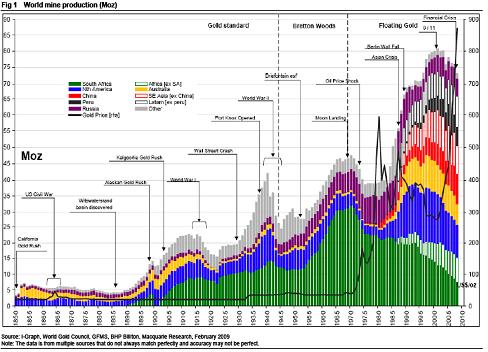
I posted this article back in April of this year. I thought I would post again. There is more to the increase in the gold price than just the collapse of the US$, devaluation of fiat currencies around the world (from Quantitative Easing (printing money) to avoid the 2nd Great Depression), Central Banks buying (instead of selling), anticipation of huge inflation..... The new gold supply side of the equation is becoming more challenging by the day. Then you also have India, China and other emerging countries gaining more wealth by the day, and add on the fact that the earth is getting more crowded with people every day, especially in these emerging countries. The article shows a graph of mine production. Gold grades have materially declined also, hence the material increase in cash cost per ounce (coupled with costs of fuel, material, labour, etc.).
I think this article provides an appreciation of how valuable our Century Mining assets are right now:
http://www.theaureport.com/pub/na/2479
Source: Brent Cook, Exploration Insights 04/14/2009
Near-Term Production
This year’s corporate mantra for a crowd of junior explorers and miners is quite simple: “get us some near term gold production fast” (or some variation thereof). The motive of course is pure: get the share price up. For companies with $2 million to $200 million in the bank the magic bullet to riches is perceived to be the acquisition of that one gold property or company that everyone else has missed. It’s a simple and easy to understand business plan that doesn’t take a genius to grasp – find it and buy it cheap while no one else is looking. I am personally aware of more than a dozen management teams pursuing this model and there are probably another 50 companies that fall into this category. I have also spent countless hours in the same search and come to the conclusion that everyone else hasn’t missed much. This particular path to corporate riches may turn out to be an elusive dream.
In this mass corporate dream the targeted gold acquisition “only” has to offer low cost production with exploration upside of a few million ounces. It should be located in a politically stable country with welcoming locals eager for the jobs a big hole in the ground will provide. A swimming pool and cold beer are also desirable attributes. Until this stealth opportunity arises, said new gold converts are cutting expenditures and shelving last year’s base metal projects until prices improve. You see, balance sheets alone cannot sustain a share price.
The problem we are all having is that quality economic gold deposits are few and far between. The most obvious confirmation of this claim is that world gold production has been steadily declining since it peaked in 2001 in spite of a nearly US$600 rise in the gold price (fig. 1 below). This goes against basic economic theory that rising prices should bring on more production and suggests a more fundamental problem in the gold industry. To wit, we are mining more gold than we are putting into production in spite of an estimated $US18 billion in gold exploration expenditure over the past five years (CIBC and Metals Economic Group).

(Fig. 1- World gold production. Source; Macquarie Research, 2009)
Global Gold Production: Down
Even more telling in the chart above is that production is declining in the historic major gold mining regions. These prolific regions: USA/Canada, Australia and South Africa have established and workable mining legislation, political stability, infrastructure, experienced mining personnel, access to capital and cold beer. For the most part it appears then that large new gold discoveries are going to come lacking at least one of the advantages just listed. This ultimately means that the deposits are going to have to offer significantly higher profit margins to compensate for the increased risks. It also means the timeline to production will more often than not be stretched over many years as political, bureaucratic and social issues are ironed out—or not. Needless to say, borrowing to build a billion dollar project in someplace like…say Angola, is going to be problematic even when the credit markets unfreeze. Net-net, gold production is unlikely to increase over the next several years at least.
Company Production: Down
There are more or less 30 major gold mining companies and untold junior companies that contribute to the roughly 74 million ounces of annual gold production. Many of the major mining companies are not keeping up with reserve replacement at their mines and are also showing declining production and reserve profiles. They have predominately been able to add ounces through acquisitions and by raising the gold price used in reserve calculations: essentially turning waste to ore. This increased gold price assumption directly translates into a lower average recovered grade and higher production costs. Margins are not expanding as one would expect due to the miners’ inability to add new high-grade reserves. CIBC World Markets calculates a four-year world recovered gold grade decline from 1.7g/t in 2004 to 1.4g/t in 2008. That’s about an $8.70 decline in the value of every tonne of ore blasted, hauled and processed.
On the acquisition side, much of the increased gold production and reserves has come by way of base metal production. When base metal prices were high, gold company production costs were lower and earnings strong due to the base metal credits. The collapse in base metal prices at the end of 2008 resulted in a remarkable 31% increase in gold production costs, according the World Gold Council figures. Lesson learned: henceforth, gold dominant deposits will command a premium.
Recognizing this lack of economic gold deposits there is a concerted effort afoot by the financial movers and shakers to cob a collection of smaller gold (and silver) producers together, creating larger producers. The idea is to tout these newly created mid-tier producers with increased “visibility” to a fresh and better-heeled audience (some might say suckers). Although this exercise will undoubtedly make money for the suits, brokers, and some shareholders, this can be more of a shell game than real wealth creation. The resultant new gold production is generally marginal at best and those buying into and financing said vehicles must make a conscious decision as to how many warts they are willing to overlook.
Experienced Explorers: Down
I have commented on the declining metal production and the 120 or so mine closures or delays previously. Layoffs within the industry are even worse now and are especially hard on the exploration end of the business. Major and junior companies are all cutting staff and contractors: Rio Tinto-14,000 gone; TeckCominco-1,400 gone; BHP-6,000 gone; Morenci Mine-1,550 gone; Stillwater-528 gone; Shore Gold-89 gone and the list goes on right down to the smallest exploration company.
Newmont Mining, “the company of choice”, is a particularly sad story. They recently raised $1.2 billion through equity and convertible notes at the same share price they traded at five years ago (see fig. 2 below). Keep in mind that over the past five years the gold price increased about $500 and they produced around 27 million ounces of gold. Newmont has fallen under the influence of accountants who are reorganizing the company (again) into four new “business centers” none of which are reporting to the VP exploration. They laid him off plus a good number of the exploration staff. Newmont’s five years of absolutely zero added shareholder value (price) despite a near doubling of the gold price points to the problem the industry as a whole faces finding new quality deposits. The fact that Newmont is cutting exploration staff suggests they don’t hold out much hope for future in-house discoveries.

(Fig. 2- Newmont Mining 5-year price chart)
We could easily see 25% of the mining industry out of work, which is a real shame given my next sentence. The pent up demand for near term gold production is not going to be satisfied through financial engineering. There are not enough economic gold deposits to go around, I’ve been looking. With declining metal prices and profits; decreased exploration staff and budgets; and increased exploration, development and production costs and timelines, the odds are stacked against a surge in new gold discoveries.
Who will make the Next Discoveries?
Nearly all the hard global economic statistics and gold supply-demand data I see points toward gold and gold companies being amongst the best performing investments over the next few years. Notwithstanding the time and effort involved, increased gold production will to a large degree have to come from new discoveries; we cannot keep kicking the same old dog properties. And, in spite of the hopes and wishes of many in the industry, sufficient cheap ready-to-go deposits just don’t exist. Given the profound difficulty of finding new gold deposits, the few lucky junior companies that are able to come up with a real gold discovery will reap dramatic share price increases.
The unlucky majority of juniors however are in for some bona fide rough times in finance world. Risk capital is tight and minerals exploration is a capital-intensive business: no capital-no business. So despite the need for new discoveries, we are going to witness the demise of many junior explorers as investors’ hopes fall in tandem with the share prices. I do not anticipate a sudden rush of money into the exploration sector that will raise all boats and certainly wouldn’t base any investments on that premise. Anyone subsidizing mediocre or low potential gold projects is probably doomed from the outset.
There is however no doubt that new gold deposits will be found. They are going to come from the hungry, intellectually astute and well-financed junior exploration companies, most of whom you have never heard of. The successful company management teams will be comprised of motivated people who are anxious to make their name in the mining industry. They will be bringing new ideas to old areas and old ideas to new areas. It is therefore imperative to focus on what appear to be legitimate, major gold discoveries and under-appreciated gold resources. Guessing won’t work in this market: economic and geologic reality is key.
I think this article provides an appreciation of how valuable our Century Mining assets are right now:
http://www.theaureport.com/pub/na/2479
Source: Brent Cook, Exploration Insights 04/14/2009
Near-Term Production
This year’s corporate mantra for a crowd of junior explorers and miners is quite simple: “get us some near term gold production fast” (or some variation thereof). The motive of course is pure: get the share price up. For companies with $2 million to $200 million in the bank the magic bullet to riches is perceived to be the acquisition of that one gold property or company that everyone else has missed. It’s a simple and easy to understand business plan that doesn’t take a genius to grasp – find it and buy it cheap while no one else is looking. I am personally aware of more than a dozen management teams pursuing this model and there are probably another 50 companies that fall into this category. I have also spent countless hours in the same search and come to the conclusion that everyone else hasn’t missed much. This particular path to corporate riches may turn out to be an elusive dream.
In this mass corporate dream the targeted gold acquisition “only” has to offer low cost production with exploration upside of a few million ounces. It should be located in a politically stable country with welcoming locals eager for the jobs a big hole in the ground will provide. A swimming pool and cold beer are also desirable attributes. Until this stealth opportunity arises, said new gold converts are cutting expenditures and shelving last year’s base metal projects until prices improve. You see, balance sheets alone cannot sustain a share price.
The problem we are all having is that quality economic gold deposits are few and far between. The most obvious confirmation of this claim is that world gold production has been steadily declining since it peaked in 2001 in spite of a nearly US$600 rise in the gold price (fig. 1 below). This goes against basic economic theory that rising prices should bring on more production and suggests a more fundamental problem in the gold industry. To wit, we are mining more gold than we are putting into production in spite of an estimated $US18 billion in gold exploration expenditure over the past five years (CIBC and Metals Economic Group).
(Fig. 1- World gold production. Source; Macquarie Research, 2009)
Global Gold Production: Down
Even more telling in the chart above is that production is declining in the historic major gold mining regions. These prolific regions: USA/Canada, Australia and South Africa have established and workable mining legislation, political stability, infrastructure, experienced mining personnel, access to capital and cold beer. For the most part it appears then that large new gold discoveries are going to come lacking at least one of the advantages just listed. This ultimately means that the deposits are going to have to offer significantly higher profit margins to compensate for the increased risks. It also means the timeline to production will more often than not be stretched over many years as political, bureaucratic and social issues are ironed out—or not. Needless to say, borrowing to build a billion dollar project in someplace like…say Angola, is going to be problematic even when the credit markets unfreeze. Net-net, gold production is unlikely to increase over the next several years at least.
Company Production: Down
There are more or less 30 major gold mining companies and untold junior companies that contribute to the roughly 74 million ounces of annual gold production. Many of the major mining companies are not keeping up with reserve replacement at their mines and are also showing declining production and reserve profiles. They have predominately been able to add ounces through acquisitions and by raising the gold price used in reserve calculations: essentially turning waste to ore. This increased gold price assumption directly translates into a lower average recovered grade and higher production costs. Margins are not expanding as one would expect due to the miners’ inability to add new high-grade reserves. CIBC World Markets calculates a four-year world recovered gold grade decline from 1.7g/t in 2004 to 1.4g/t in 2008. That’s about an $8.70 decline in the value of every tonne of ore blasted, hauled and processed.
On the acquisition side, much of the increased gold production and reserves has come by way of base metal production. When base metal prices were high, gold company production costs were lower and earnings strong due to the base metal credits. The collapse in base metal prices at the end of 2008 resulted in a remarkable 31% increase in gold production costs, according the World Gold Council figures. Lesson learned: henceforth, gold dominant deposits will command a premium.
Recognizing this lack of economic gold deposits there is a concerted effort afoot by the financial movers and shakers to cob a collection of smaller gold (and silver) producers together, creating larger producers. The idea is to tout these newly created mid-tier producers with increased “visibility” to a fresh and better-heeled audience (some might say suckers). Although this exercise will undoubtedly make money for the suits, brokers, and some shareholders, this can be more of a shell game than real wealth creation. The resultant new gold production is generally marginal at best and those buying into and financing said vehicles must make a conscious decision as to how many warts they are willing to overlook.
Experienced Explorers: Down
I have commented on the declining metal production and the 120 or so mine closures or delays previously. Layoffs within the industry are even worse now and are especially hard on the exploration end of the business. Major and junior companies are all cutting staff and contractors: Rio Tinto-14,000 gone; TeckCominco-1,400 gone; BHP-6,000 gone; Morenci Mine-1,550 gone; Stillwater-528 gone; Shore Gold-89 gone and the list goes on right down to the smallest exploration company.
Newmont Mining, “the company of choice”, is a particularly sad story. They recently raised $1.2 billion through equity and convertible notes at the same share price they traded at five years ago (see fig. 2 below). Keep in mind that over the past five years the gold price increased about $500 and they produced around 27 million ounces of gold. Newmont has fallen under the influence of accountants who are reorganizing the company (again) into four new “business centers” none of which are reporting to the VP exploration. They laid him off plus a good number of the exploration staff. Newmont’s five years of absolutely zero added shareholder value (price) despite a near doubling of the gold price points to the problem the industry as a whole faces finding new quality deposits. The fact that Newmont is cutting exploration staff suggests they don’t hold out much hope for future in-house discoveries.
(Fig. 2- Newmont Mining 5-year price chart)
We could easily see 25% of the mining industry out of work, which is a real shame given my next sentence. The pent up demand for near term gold production is not going to be satisfied through financial engineering. There are not enough economic gold deposits to go around, I’ve been looking. With declining metal prices and profits; decreased exploration staff and budgets; and increased exploration, development and production costs and timelines, the odds are stacked against a surge in new gold discoveries.
Who will make the Next Discoveries?
Nearly all the hard global economic statistics and gold supply-demand data I see points toward gold and gold companies being amongst the best performing investments over the next few years. Notwithstanding the time and effort involved, increased gold production will to a large degree have to come from new discoveries; we cannot keep kicking the same old dog properties. And, in spite of the hopes and wishes of many in the industry, sufficient cheap ready-to-go deposits just don’t exist. Given the profound difficulty of finding new gold deposits, the few lucky junior companies that are able to come up with a real gold discovery will reap dramatic share price increases.
The unlucky majority of juniors however are in for some bona fide rough times in finance world. Risk capital is tight and minerals exploration is a capital-intensive business: no capital-no business. So despite the need for new discoveries, we are going to witness the demise of many junior explorers as investors’ hopes fall in tandem with the share prices. I do not anticipate a sudden rush of money into the exploration sector that will raise all boats and certainly wouldn’t base any investments on that premise. Anyone subsidizing mediocre or low potential gold projects is probably doomed from the outset.
There is however no doubt that new gold deposits will be found. They are going to come from the hungry, intellectually astute and well-financed junior exploration companies, most of whom you have never heard of. The successful company management teams will be comprised of motivated people who are anxious to make their name in the mining industry. They will be bringing new ideas to old areas and old ideas to new areas. It is therefore imperative to focus on what appear to be legitimate, major gold discoveries and under-appreciated gold resources. Guessing won’t work in this market: economic and geologic reality is key.
Tuesday, December 1, 2009

In my view, numbers wise, no reason for the share price to trade below $.52 per share, even without any additional financings
By the way, I fully expect all financings to close. In fact, I wouldn't discount us maybe getting some extra positive news.
However, let's work with worst case scenario for this analysis. Let's see what we are working with if we do not get another financing - strictly hypothetically speaking.
Century's remaining balance sheet obligations:
*Net AP and Accrued Liabilities - $5.6M (net of $8.3M AR and est. employee pymt of $350K made subsequent to quarter end)
*IQ Debt - $16.4M
*MRI Debenture - $1.0M (Century is trying to reduce this due to MRI's failure to fulfill its obligation)
*Tamerlane - $153K
*Current Other LT Debt (Equip. lease) - $340K
*Other LT Debt (Equip. lease) - $241K
*Future Income Tax Liabilities - $635K ($935K less $300K per Quebec newspapers, this amount appears to have been paid subsequent to quarter end, municipal taxes, etc.)
NET remaining Century Balance Sheet obligations (before adjusting for cash position) = $24.3M
I have excluded the $2.6M ($2.2M + $.4M) Gerald Metals obligation as they are already secured by the 2,015 unfinished ounces residing in Lamaque's inventory)
Naturally, I have also excluded the environment bond amount, as we already know about the Quebec payment subsequent to quarter end.
Cash sitution (let's assuming no more financings, not even the current $4M to be closed off soon):
*Current cash - $2.0M (likely, based on previous $4M financing and recent Cash Flow)
*New cash next 90 days - $2.0M (assuming Q3 production of 4,561 and US$486 cash cost, even after removing funds for Corp G&A, ongoing mine development, taxes, etc.)
Cash Position next 90 days = $4.0M
NET remaining Century Balance Sheet obligations (After adjusting for cash position):
$20.3M ($24.3M - $4.0M)
Century's share price based on Q3's Net Income:
Century posted a Net Income of $.012 per share in Q3 (equates to $.048 on an annualized basis), even using Century's current share count of 226,000,000. There is every reason to believe that this Net Income level is sustainable. The gold price has gone from a Q3 average of US$960 to US$1,200 currently. With a capital injection of US$1.5 to expand San Juan's milling capabilities, Century's quarterly production ounces can increase from the Q3 level of 4,561 to 6,500.
Using a conservative PE (Price to Earnings) ratio of 10, this equates to a Century share price of $.48 (this is even without Lamaque in production).
Let's assume we had to sell Lamaque (again, strictly hypothetically speaking, from a worst case scenario perspective):
By the way, I am aware of at least 2 solid companies that were interested in executing a merger with Century (prior to Century going with Finskiy and Scola) so there is definitely interest in Lamaque out there - Century confirmed via several documents and conference calls that other parties have showed interests in doing a deal with Century. One would think that those interests would be even more favourable to Century now that the gold price is US1,200 (with higher potential).
Let's further assume fire sale price scenarios.
Scenario 1, sale price = $30M for Lamaque
Scenario 2, sale price = $50M for Lamaque
Scenario 3, sale price = $70M for Lamaque
Scenario 4, sale price = $100M for Lamaque
Remaining cash after retirement of the $20.4M balance sheet obligation:
Scenario 1 = $9.7M or $.04 per share cash remaining
Scenario 2 = $29.7M or $.13 per share cash remaining
Scenario 3 = $49.7M or $.22 per share cash remaining
Scenario 4 = $79.7M or $.35 per share cash remaining
Share price (Q3 Net Income level + remaining Cash from transaction):
Scenario 1 = $.52 per share ($.48 + $.04)
Scenario 2 = $.61 per share ($.48 + $.13)
Scenario 3 = $.70 per share ($.48 + $.22)
Scenario 4 = $.83 per share ($.48 + $.35)
In my view, (numbers wise) I see no reason for Century trading as low as $.26 per share right now, with or without any future financings. The improvements in the Balance Sheet over the past year, coupled with the gold environment, has reduced the risks substantially, in my view.
However, let's work with worst case scenario for this analysis. Let's see what we are working with if we do not get another financing - strictly hypothetically speaking.
Century's remaining balance sheet obligations:
*Net AP and Accrued Liabilities - $5.6M (net of $8.3M AR and est. employee pymt of $350K made subsequent to quarter end)
*IQ Debt - $16.4M
*MRI Debenture - $1.0M (Century is trying to reduce this due to MRI's failure to fulfill its obligation)
*Tamerlane - $153K
*Current Other LT Debt (Equip. lease) - $340K
*Other LT Debt (Equip. lease) - $241K
*Future Income Tax Liabilities - $635K ($935K less $300K per Quebec newspapers, this amount appears to have been paid subsequent to quarter end, municipal taxes, etc.)
NET remaining Century Balance Sheet obligations (before adjusting for cash position) = $24.3M
I have excluded the $2.6M ($2.2M + $.4M) Gerald Metals obligation as they are already secured by the 2,015 unfinished ounces residing in Lamaque's inventory)
Naturally, I have also excluded the environment bond amount, as we already know about the Quebec payment subsequent to quarter end.
Cash sitution (let's assuming no more financings, not even the current $4M to be closed off soon):
*Current cash - $2.0M (likely, based on previous $4M financing and recent Cash Flow)
*New cash next 90 days - $2.0M (assuming Q3 production of 4,561 and US$486 cash cost, even after removing funds for Corp G&A, ongoing mine development, taxes, etc.)
Cash Position next 90 days = $4.0M
NET remaining Century Balance Sheet obligations (After adjusting for cash position):
$20.3M ($24.3M - $4.0M)
Century's share price based on Q3's Net Income:
Century posted a Net Income of $.012 per share in Q3 (equates to $.048 on an annualized basis), even using Century's current share count of 226,000,000. There is every reason to believe that this Net Income level is sustainable. The gold price has gone from a Q3 average of US$960 to US$1,200 currently. With a capital injection of US$1.5 to expand San Juan's milling capabilities, Century's quarterly production ounces can increase from the Q3 level of 4,561 to 6,500.
Using a conservative PE (Price to Earnings) ratio of 10, this equates to a Century share price of $.48 (this is even without Lamaque in production).
Let's assume we had to sell Lamaque (again, strictly hypothetically speaking, from a worst case scenario perspective):
By the way, I am aware of at least 2 solid companies that were interested in executing a merger with Century (prior to Century going with Finskiy and Scola) so there is definitely interest in Lamaque out there - Century confirmed via several documents and conference calls that other parties have showed interests in doing a deal with Century. One would think that those interests would be even more favourable to Century now that the gold price is US1,200 (with higher potential).
Let's further assume fire sale price scenarios.
Scenario 1, sale price = $30M for Lamaque
Scenario 2, sale price = $50M for Lamaque
Scenario 3, sale price = $70M for Lamaque
Scenario 4, sale price = $100M for Lamaque
Remaining cash after retirement of the $20.4M balance sheet obligation:
Scenario 1 = $9.7M or $.04 per share cash remaining
Scenario 2 = $29.7M or $.13 per share cash remaining
Scenario 3 = $49.7M or $.22 per share cash remaining
Scenario 4 = $79.7M or $.35 per share cash remaining
Share price (Q3 Net Income level + remaining Cash from transaction):
Scenario 1 = $.52 per share ($.48 + $.04)
Scenario 2 = $.61 per share ($.48 + $.13)
Scenario 3 = $.70 per share ($.48 + $.22)
Scenario 4 = $.83 per share ($.48 + $.35)
In my view, (numbers wise) I see no reason for Century trading as low as $.26 per share right now, with or without any future financings. The improvements in the Balance Sheet over the past year, coupled with the gold environment, has reduced the risks substantially, in my view.
Outlook, from MD&A
The Company continues to add ounces to the Lamaque resource base and with combined reserves and resources currently over 6 million ounces of gold the mine
The last number published for Lamaque was 5.5M ounces (June'09). Is the over 6.0M currently for Lamaque a typo? Or, have they added ounces since June'09. Perhaps they adjusted it to reflect the lower cutoff grade (from 2.5 g/t to 2.1 g/t - going from using US$800 gold price to US$900), as I've been anticipating they will eventually. If the current Lamaque number is truly over 6.0M then the overall company number might be close to 6.5M currently (when adding in SJ). I guess we'll see eventually.
The combined production forecast of both mines when Lamaque is at capacity will be over 130,000 ounces per year at cash cost of US$450-US$500 per ounce.
We are probably talking about a couple of years down the road. I take it the break down will be 100,000 for Lamaque and 30,000 for San Juan. They can only set the targets based on the 1.3M current reserves. What's interesting is that the majority of the 2.6M ounces residing 1000 ft (300 meters) of the surface have not been moved into P&P Reserves as yet. Century has launched a $4M exploring program. This should allow more of the 2.6M ounces to be moved into higher resource categories, including P&P Reserves. If a larger number of those ounces are moved into P&P Reserves then hopefully the company will look to fast track production to the 100,000 per year level at Lamaque. Also, hopefully they will look to increase the long term production target beyond 100,000 (mill capacity is in place to handle much higher production). Given the proximity to the surface, theoretically, mine development and mining of these ounces should be independent of dewatering the lower levels and refurbishing the shafts (required to drill and mine the areas below 1200 ft) - assuming there is sufficient space to maneuver around for all initiatives.
First thing is first though, we need to close off the financings then we need to establish profitable production at Lamaque. The US1,200 (+) gold price will be extremely helpful.
From the MD&A:
"The outlook for Lamaque technically is exceptional. The Company continues to add ounces to the Lamaque resource base and with combined reserves and resources currently over 6 million ounces of gold the mine should be a significant producer for many years to come. The combined production forecast of both mines when Lamaque is at capacity will be over 130,000 ounces per year at cash cost of US$450-US$500 per ounce. Management has continued to focus on the technical aspects of the project and has continued to support the group of employees and staff at the mine through this difficult time. The fact that the project successfully passed the stringent due diligence process is evidence that the project is robust and is ready to restart when the financing is closed."
"The outlook for San Juan is also positive, but San Juan can only achieve its production goals for 2010 when capital needed to complete the refurbishment of the milling facilities is available. Until closing of the larger financings, cash continues to flow from Peru to support management and head office expenses, leaving the necessary mill expansion and other cost saving efforts unfunded."
"The Company’s assets at Lamaque and San Juan are very good projects and the potential to realize significant shareholder value from these existing assets is excellent. Management’s focus is to work diligently to close the announced financing packages by the middle of December. This will ensure that the Company’s working capital deficit is eliminated, and the necessary start up and expansion work is completed at the Lamaque and San Juan mines. When this happens the company will have two long life assets that have the potential to generate substantial cash flow at current and projected gold prices. Until then, the Company will not be completing any further acquisitions or be spending any corporate cash flow on its other existing development projects."
"With gold approaching US$1,200 per ounce and the Company is ready to restart the Lamaque project the outlook for the Company has improved significantly. Management looks forward to a robust year in 2010 as we work to implement all the Company’s growth plans."
The last number published for Lamaque was 5.5M ounces (June'09). Is the over 6.0M currently for Lamaque a typo? Or, have they added ounces since June'09. Perhaps they adjusted it to reflect the lower cutoff grade (from 2.5 g/t to 2.1 g/t - going from using US$800 gold price to US$900), as I've been anticipating they will eventually. If the current Lamaque number is truly over 6.0M then the overall company number might be close to 6.5M currently (when adding in SJ). I guess we'll see eventually.
The combined production forecast of both mines when Lamaque is at capacity will be over 130,000 ounces per year at cash cost of US$450-US$500 per ounce.
We are probably talking about a couple of years down the road. I take it the break down will be 100,000 for Lamaque and 30,000 for San Juan. They can only set the targets based on the 1.3M current reserves. What's interesting is that the majority of the 2.6M ounces residing 1000 ft (300 meters) of the surface have not been moved into P&P Reserves as yet. Century has launched a $4M exploring program. This should allow more of the 2.6M ounces to be moved into higher resource categories, including P&P Reserves. If a larger number of those ounces are moved into P&P Reserves then hopefully the company will look to fast track production to the 100,000 per year level at Lamaque. Also, hopefully they will look to increase the long term production target beyond 100,000 (mill capacity is in place to handle much higher production). Given the proximity to the surface, theoretically, mine development and mining of these ounces should be independent of dewatering the lower levels and refurbishing the shafts (required to drill and mine the areas below 1200 ft) - assuming there is sufficient space to maneuver around for all initiatives.
First thing is first though, we need to close off the financings then we need to establish profitable production at Lamaque. The US1,200 (+) gold price will be extremely helpful.
From the MD&A:
"The outlook for Lamaque technically is exceptional. The Company continues to add ounces to the Lamaque resource base and with combined reserves and resources currently over 6 million ounces of gold the mine should be a significant producer for many years to come. The combined production forecast of both mines when Lamaque is at capacity will be over 130,000 ounces per year at cash cost of US$450-US$500 per ounce. Management has continued to focus on the technical aspects of the project and has continued to support the group of employees and staff at the mine through this difficult time. The fact that the project successfully passed the stringent due diligence process is evidence that the project is robust and is ready to restart when the financing is closed."
"The outlook for San Juan is also positive, but San Juan can only achieve its production goals for 2010 when capital needed to complete the refurbishment of the milling facilities is available. Until closing of the larger financings, cash continues to flow from Peru to support management and head office expenses, leaving the necessary mill expansion and other cost saving efforts unfunded."
"The Company’s assets at Lamaque and San Juan are very good projects and the potential to realize significant shareholder value from these existing assets is excellent. Management’s focus is to work diligently to close the announced financing packages by the middle of December. This will ensure that the Company’s working capital deficit is eliminated, and the necessary start up and expansion work is completed at the Lamaque and San Juan mines. When this happens the company will have two long life assets that have the potential to generate substantial cash flow at current and projected gold prices. Until then, the Company will not be completing any further acquisitions or be spending any corporate cash flow on its other existing development projects."
"With gold approaching US$1,200 per ounce and the Company is ready to restart the Lamaque project the outlook for the Company has improved significantly. Management looks forward to a robust year in 2010 as we work to implement all the Company’s growth plans."
Subscribe to:
Posts (Atom)